
Cycloptic Modernism
The Palais de Justice in Brussels was for a time the biggest building in Europe

European capitals often feature a striking architectural hodgepodge that blights a significant part of their skyline. These eyesores are invariably from the late nineteenth century. Il Vittoriano in Rome, or Sacré Cœur in Paris. Overbearing works that don’t bother to camouflage the megalomania of their creators. Pharaonic tributes to dead leaders, or else idealized apologies for one massacre or another.
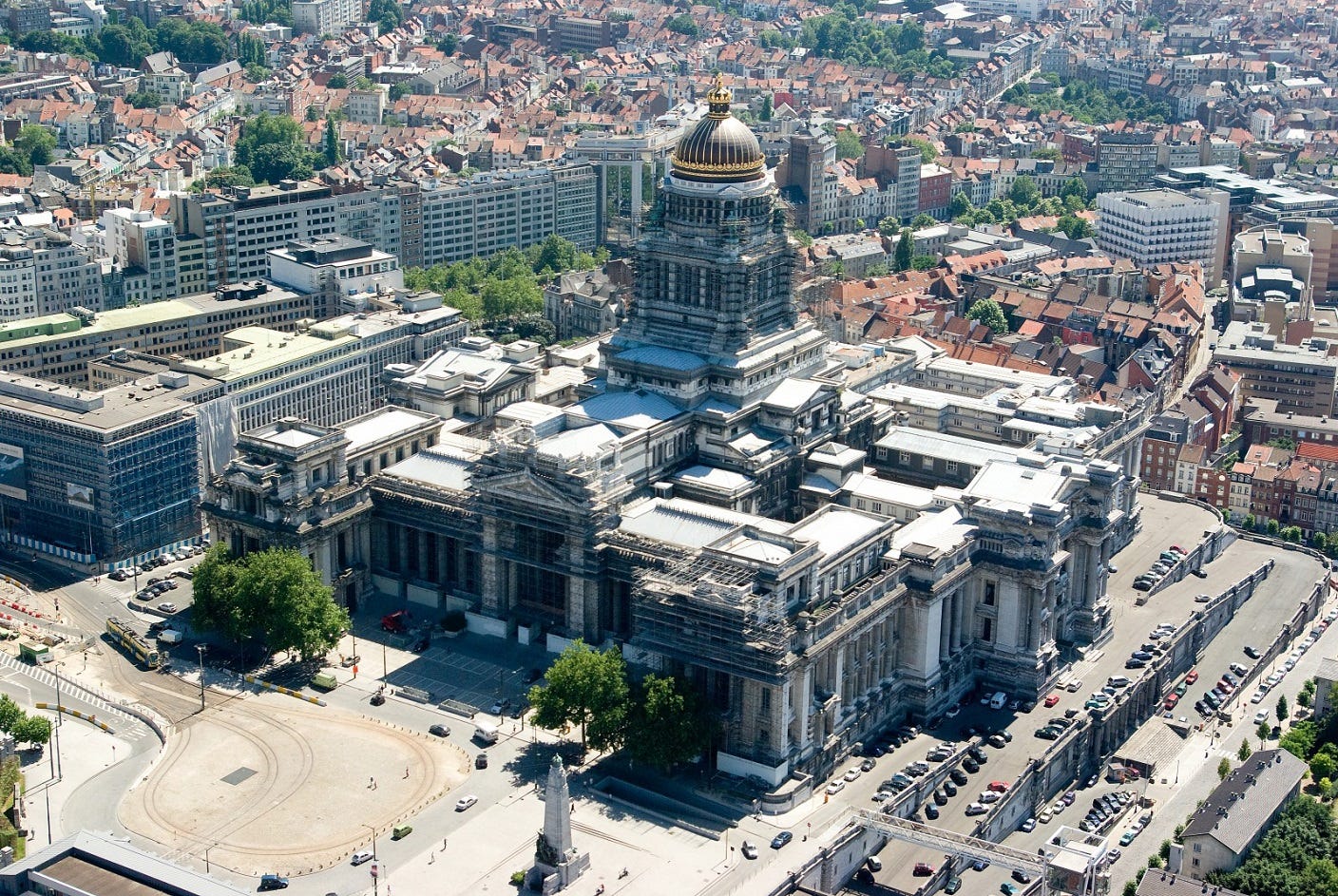
Brussels’s equivalent is Joseph Poelart’s folly, the Palais de Justice. On its completion in 1883 it was Europe’s largest building. It is as unmissable as the Eiffel Tower, although far less iconic.
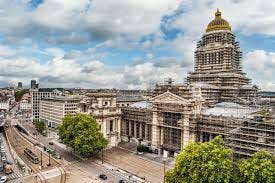
The most insistently attention-grabbing architectural style, for me, is Gothic: asymmetrical spires thrusting heavenward, unity be damned. The Palais de Justice seizes your attention in a different way: through a kind of exhausting immensity. Cupolas, capitals, porticos, columns, a kind of hysterical Coal Age municipalism.
Its overstuffed quality, derided by Octave Mirbeau as “Tibetan” and “Papuan,” may have been just the thing that enchanted me when I was a visiting teenager. While classical forms make a clear declaration, the Palais de Justice is a run-on sentence. One wonders about secret entrances or undiscovered passageways. Poelart designed the facades, the interiors and everything else, including every detail of the furniture. Anyone who has looked at it since the 1980s has also been made to enjoy a permanent-seeming exoskeleton of scaffolding: like the law itself, Belgium’s main courthouse seems permanently under repair.
Mirbeau reached for orientalist comparisons in describing the cacophony of the Palais de Justice, but I prefer the summary offered by local Art Nouveau practitioner Victor Horta: “This is Cyclopean architecture, dreamed up by hands with no awareness of human scale.” If I understand Horta correctly, he’s accusing Poelart himself of building like a one-eyed giant.
Poelart himself might agree with Horta. It’s clear that Poelart was not interested in humane, transparent court administration. He was building something to alienate and overwhelm. Seekers of justice could tremble before the obvious inhumanity of the institution they encountered, and then be obliterated.
. . .
The population of Brussels increased sevenfold over the nineteenth century. King Leopold II himself promulgated a massive modernization plan, looking over his shoulder competitively at Paris and Rome. The new courthouse deliberately surpassed St Peter’s and is more than 26,000 square meters (about 280,000 square feet).
Similar to the way the Lincoln Memorial closes off the Washington Mall’s view to the west, the Palais interrupts the view from the Royal Palace. Pre-Palais, the king could look down the Rue de la Régence on up to Galgenberg, the hill that was a traditional site for summary executions. Poelart and his nation-making co-conspirators sought to replace the gallows with an aesthetically overpowering symbol of rationalized justice. I read in the Everyman guide that in the parlance of the working-class quarter of Marolles, partially demolished to make way for the Palais de Justice, “architek” is a vulgar term of abuse.
On the other side of town, the headquarters of NATO and the EU are evidence of a 20th century plan to create a city of hypercosmopolitan rule-followers. The Palais de Justice speaks of a similar desire for Belgium to remake itself.
. . .
Debora Silverman explains the distinctively nineteenth-century overlap between idealistic left-wing lawyers, experimental art and poetry, and brutal colonialist extraction. They’re all evoked by this gigantic courthouse building.
Her account centers on an address given by the French poet Paul Verlaine at the Palais de Justice in 1893. Twenty years before that, in Silverman’s telling, a very different Belgian legal culture jailed Verlaine for two years for shooting his lover, Arthur Rimbaud. But by 1893 Verlaine had become an eminent artistic figure, little matter that he dressed like a pauper and could barely stay sober for a brief lecture tour.
Verlaine’s hosts were not just artistic avant-gardists, they were also the nation’s leading lawyers. Edmond Picard, Octave Maus, Carton de Wiart, and Jules Destrée were arts-minded lawyers, and Émile Verhaeren and Georges Rodenbach were literary writers with legal training. These were liberal elites much preoccupied with art and literature, and with the consolidation of national power. These lawyer-littérateurs sat in a large auditorium, where the accused would normally sit, to hear Verlaine’s talk.
When they weren’t hosting bohemian poets, these men were consolidating the ancient customs of nine provinces and 2600 communes, all of which have constitutional protection. Belgium was only a few decades old, and it took creative legal minds to centralize, modernize, and even in some sense decolonize the country. The task was to preserve local legal practice, and to unbuckle Belgium from French, Dutch and Austrian Habsburg traditions.
And it was all happening at the Palais de Justice. The Court of Cassation (aka the supreme court), the Appeals Court, the Assizes Court, the Courts of First Instance, the Military Court, the Court of War, and the courts of the peace and police services are all housed in the same building. Their young country was modernizing and centralizing, and unbuckling itself from French, Dutch, and Austrian Habsburg tradition, and it was all happening at the Palais de Justice.
Verlaine thrilled the lawyers. They applauded his recitation of prison diaries. The young Belgian jurists celebrated their curious union of art-making and state-making. And it would be nice to leave the narrative there, with the art-rebel and the A students eating at the same lunch table, but Silverman takes pains to remind us of the purpose of that ultramodern legal edifice.
The dynamism of young Belgium existed so that the king could plunder the Congo. Bar association leader Edmond Picard’s machinations in the Palais de Justice made Leopold II an absolute ruler of the Congo, even as the king enjoyed little direct political influence in Belgium itself. The project of Belgian modernization cannot be separated from the racism and antisemitism that inspired it.
But maybe the image of the grandiose courthouse can be seen anew. Graphic artist François Schuiten depicts the Palais de Justice throughout his work. His series Les Cités Obscures bounces between political satire, pseudo-documentary and psychological drama while lovingly depicting world architectural forms.
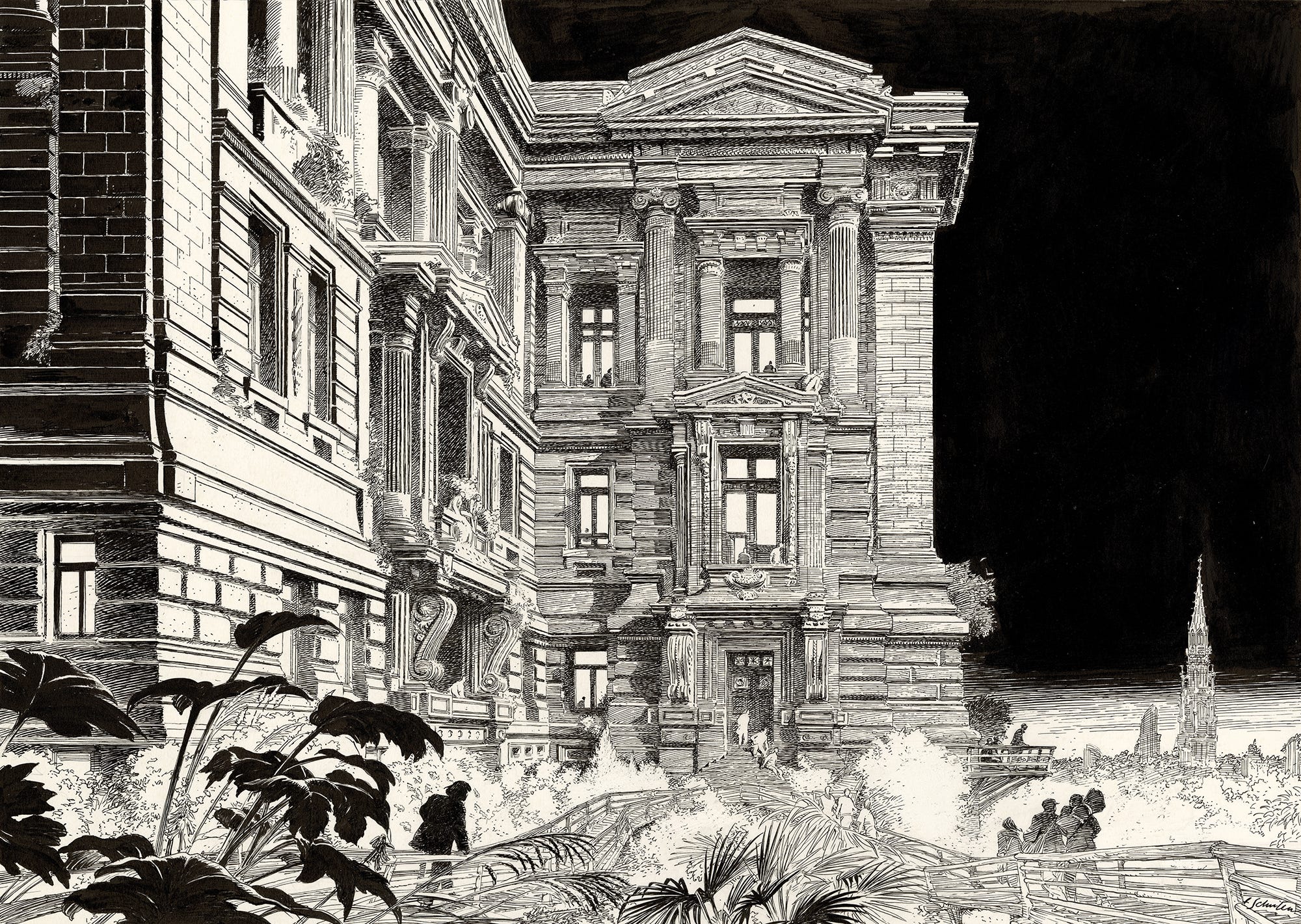

Belgium came, tastelessly, into its own as a nineteenth century powerhouse, uniting modern administration with modern aesthetics, and cruelly exploiting both its own neighborhoods and its distant colony. But we can still have fun with the way it looks.
Further Reading:
Leo Cendrowicz, “The Unfathomable Scale of Justice,” The Brussels Times Magazine, (Feb 19, 2023).
Debora Silverman, “‘Modernité Sans Frontières:’ Culture, Politics, and the Boundaries of the Avant-Garde in King Leopold's Belgium, 1885-1910,” American Imago, Vol. 68 No. 4, pp. 707-97 (Winter 2011).